Introdution
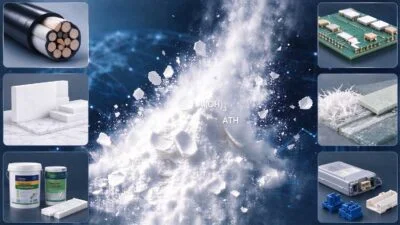
For mineral producers making Aluminium Trihydroxide (ATH, also Alumina Trihydrate) flame‑retardant fillers, picking the wrong processing configuration creates costly issues: crystal water thermal decomposition, unstable particle size, low‑quality surface coating, or failing to hit your hourly production target. Your ATH production line should always be built around three core goals: target powder fineness, required output capacity, and whether finished ATH needs surface activation modification. This practical buying guide walks you through key process stages and helps you choose suitable combinations of Turbo Flash Disintegration & Drying Machine, grinding mills, Air Classifier and Three‑Roller Vortex ATH Surface Activation Modification Mill for cable, plastic, coating and artificial‑stone‑grade ATH filler.
1. Three Core Decision‑Making Metrics Before You Compare ATH Equipment
Many plant buyers start by comparing machine price, skipping core specification alignment. For ATH, three factors define your whole‑line layout, plus one critical material constraint: ATH will lose crystal water and flame‑retardant performance if material temperature exceeds 150 °C throughout every processing step.
- Target fineness (D97 micron range): Confirm exact D97 value, maximum allowed oversized residue. ATH runs from medium filler grades D97 10‑45 μm down to sub‑micron high‑end electronic grades D97 3‑10 μm.
- Hourly output capacity: Distinguish between large‑volume bulk production and small‑batch high‑purity premium ATH; finer particle sizes always lower real‑world throughput.
- Modification requirement: Decide whether you produce uncoated raw ATH powder, or need silane / stearic‑acid surface‑activated ATH for better polymer compatibility.
- Raw feed condition: Are you processing wet ATH filter‑cake, pre‑ground powder or rework material? Wet filter‑cake normally requires pre‑treatment drying and de‑agglomeration.
2. Key Process Stages and Corresponding ATH Equipment Options
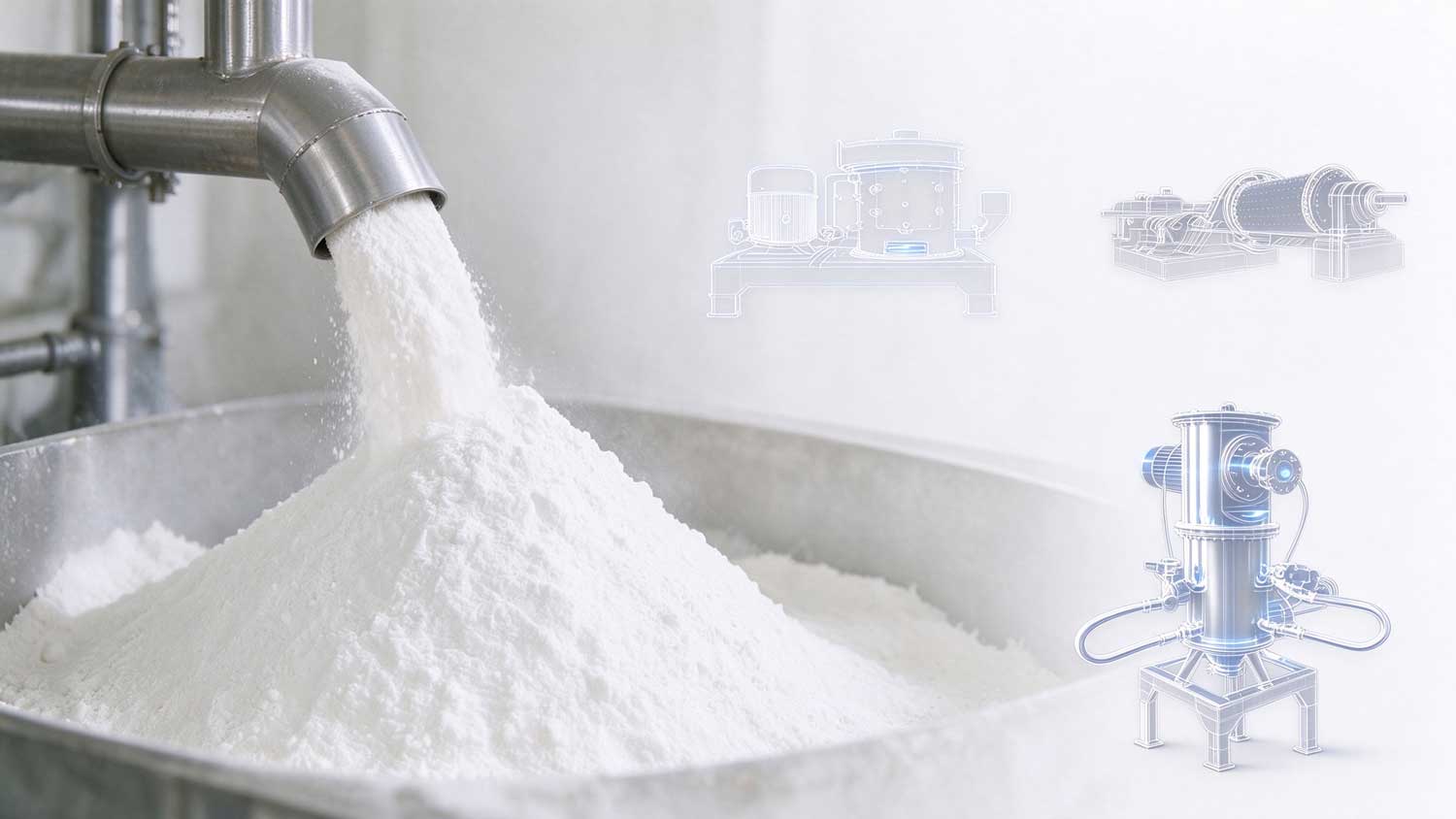
A full ATH workflow follows: raw‑material pre‑treatment → ultrafine low‑temperature grinding → precision air classification → optional surface activation modification. Every unit influences final ATH quality.
2.1 Pre‑treatment: Turbo Flash Disintegration & Drying Machine
Turbo Flash Disintegration & Drying Machine is dedicated to wet ATH filter cake and damp caked ATH feedstock. After filter pressing, ATH often forms hard lumps and holds uneven surface moisture. If fed directly into grinding mills, these lumps will not break fully, moisture will cause internal agglomeration during milling, and finished powder will have inconsistent particle size and poor flowability.
Inside this machine, high‑speed rotating blades first shear and crush solid lumps into loose primary particles. Hot air at controlled low temperature (below 110°C) flows through the chamber at high velocity, carrying fine particles upward while evaporating surface moisture instantly. Residence time is very short, so ATH never stays exposed to heat for long. It delivers dry, dispersed powder with stable moisture usually below 0.3%. It cannot grind ATH down to target D97 fineness; its only job is de‑lumping and drying. If your incoming ATH is already dry free‑flow powder, this machine is not required.
2.2 Ultrafine low‑temperature grinding options for different fineness & output
All four grinding models use cooling structures to keep material temperature ≤110 °C and protect ATH crystal water. Each has distinct particle shape, contamination risk, throughput window and maintenance features for ATH production:
- Air Classifier Mill (ACM): This is an integrated impact grinding mill with built‑in dynamic classification wheel. Raw ATH enters the grinding chamber and hits high‑speed rotating hammers, using impact and shear force to break particles. The internal classifier wheel separates fine qualified powder and sends coarse particles back to the grinding zone automatically.It works best for D97 10–45 μm ATH. The water‑jacket cooling on the chamber wall continuously removes friction heat, avoiding hot spots that risk crystal water loss. Ceramic lining is optional; this cuts iron contamination for coating and low‑smoke plastic grades. It is flexible for frequent grade switching, easy to clean between batches. The main limitation: it is not economical for very large tonnage mass production, and cannot reach stable sub‑micron ATH efficiently.
- Ring Roller Mill: This is a high‑capacity closed‑circuit grinding system designed for continuous bulk ATH production. Material falls between rotating rollers and a stationary ring; compression and mild grinding force reduce particle size. Ground powder is lifted by internal airflow to the built‑in classifier. Oversized particles drop back for repeated grinding.Its sweet spot is D97 5–45 μm ATH. Compared with impact‑type Air Classifier Mill, it consumes far less power per ton and supports steady high hourly output. The grinding chamber is water‑cooled to keep ATH temperature safe. Ceramic roller and ring lining can be fitted for high‑whiteness, low‑iron ATH used in zero‑halogen cable compounds. The tradeoff: it is less suitable for frequent product changes. Cleaning takes longer, and it struggles if you need narrow particle size distribution for premium electronic ATH.
- Spiral Jet Mill: It is a medium‑capacity jet mill driven by compressed air. High‑speed air nozzles accelerate ATH particles inside the spiral chamber. Particles collide against each other instead of hitting metal components, so metal contamination stays low. Internal vortex classification separates finished fines and coarse returns.Target range D97 5–40 μm. Compared with fluidized bed opposed jet mill, it uses less compressed air and runs at higher throughput. It is popular for mid‑scale high‑purity flame retardant ATH for plastic and masterbatch. It produces rounder particle shapes and fewer sharp fragments than mechanical impact mills. Limitation: airflow parameters are sensitive to feed moisture; damp ATH will stick on the chamber wall and reduce classification stability. It also cannot reliably produce consistent sub‑micron ATH below 3μm.
- Fluidized Bed Opposed Jet Mill: This is the premium jet mill for high‑end fine ATH. Multiple opposed air nozzles create a fluidized bed of ATH particles. High‑energy particle‑to‑particle collision delivers ultra‑fine grinding without metal contact. Built‑in high‑precision dynamic classifier controls the cut point tightly.It is the reliable choice for D97 3–10 μm sub‑micron ATH for electronic components and high‑performance cable sheathing. Compressed air expansion naturally cools the grinding zone, so material temperature often stays below 80°C, the safest condition for ATH crystal water. Iron contamination is extremely low. The downside is operating cost: compressed‑air consumption is high. It is not a good fit for large‑volume ordinary industrial ATH, where ring roller mill is much cheaper to run.
2.3 Precision particle separation: Air Classifier standalone unit
Air Classifier is a dedicated separation machine with no grinding function. It takes powder feed from upstream mills and sorts particles strictly by aerodynamic size. A rotating classification wheel creates centrifugal force; fine qualified ATH passes through the wheel, while coarse oversized particles are rejected and sent back to the mill for regrinding.
You add this standalone Air Classifier when the built‑in classifier on your mill cannot meet your specification. Typical use cases: cable‑grade ATH requiring oversized residue ≤0.1%, very narrow particle distribution, or strict separation of ultra‑fine fractions. It can run in closed loop with Ring Roller Mill, Spiral Jet Mill or Fluidized Bed Opposed Jet Mill. Ceramic‑lined rotors and housing are available for low‑iron ATH grades. Adding it improves finished powder consistency, but it adds extra footprint and power consumption. For standard commercial ATH with loose particle size tolerance, the mill’s native classification is enough, and you do not need this unit.
2.4 Surface‑activation modification: Three‑Roller Vortex ATH Surface Activation Modification Mill
Three‑Roller Vortex ATH Surface Activation Modification Mill works only after grinding and classification. It is a continuous dry surface coating machine for ATH powder. Pre‑weighed ATH and modifier (silane coupling agent or stearic acid) enter the multi‑stage vortex chamber. Three staggered high‑speed rotors create strong shear and turbulence. The powder and modifier mix evenly, and self‑friction generates gentle heat to activate the coating reaction, kept below 110°C to protect ATH crystal water.
It breaks up micro‑agglomerates formed after ultrafine grinding while coating each particle. Good coating improves compatibility between ATH and polymer resin, reducing viscosity rise in plastics, coatings and rubber. It is available for all ATH fineness grades from D97 5μm up to D97 45μm. It is not suitable for raw unground ATH lumps. If agglomerates are carried over from poor drying or grinding stages, the modification mill cannot fix those large hard clusters, and final coating will be patchy. If you only sell unmodified raw ATH filler, you skip this machine entirely.
3. Typical ATH Production Line Configuration Reference Table
| Production Scenario | Target ATH Spec | Recommended Complete Equipment Layout |
|---|---|---|
| Large‑volume general‑grade flame‑retardant filler, wet filter‑cake feed | D97 10‑45 μm, unmodified or modified ATH | Turbo Flash Disintegration & Drying Machine + Ring Roller Mill + optional Air Classifier + optional Three‑Roller Vortex ATH Surface Activation Modification Mill |
| Medium‑batch multi‑grade ATH production, dry feedstock | D97 10‑45 μm, flame‑retardant for coating / plastic | Air Classifier Mill + optional standalone Air Classifier + optional Three‑Roller Vortex ATH Surface Activation Modification Mill |
| Mid‑scale high‑purity medium‑fine ATH | D97 5‑40 μm, low‑iron flame‑retardant filler | Turbo Flash Disintegration & Drying Machine (if wet cake) + Spiral Jet Mill + optional Air Classifier + optional Three‑Roller Vortex ATH Surface Activation Modification Mill |
| Small‑medium‑batch premium sub‑micron electronic / high‑end cable ATH | D97 3‑10 μm ultra‑pure ATH | Turbo Flash Disintegration & Drying Machine (if wet cake) + Fluidized Bed Opposed Jet Mill + optional Air Classifier + Three‑Roller Vortex ATH Surface Activation Modification Mill |
Important reminder: Pre‑treatment with Turbo Flash Disintegration & Drying Machine is mandatory if raw input is wet ATH filter‑cake. If you only produce unmodified raw ATH powder, you do not install the Three‑Roller Vortex ATH Surface Activation Modification Mill.
4. Common Costly Mistakes in ATH Processing Line Selection
- Ignoring thermal‑decomposition risk: selecting equipment without cooling functions; ATH crystal water will be lost once material temperature exceeds 150 °C, ruining flame‑retardant performance.
- Over‑specifying ultrafine jet‑mill equipment for bulk medium‑fineness ATH, leading to excessive energy cost and poor throughput.
- Forgetting standalone Air Classifier when you require extremely low oversized particle residue for cable‑grade ATH, relying only on mill‑built‑in classification.
- Adding surface‑modification mill while hard agglomerates remain from poor pre‑treatment; modification cannot fully fix agglomeration issues created in earlier grinding and drying stages.
- Buying steel‑lined grinding units for high‑end low‑iron ATH; metal wear will push iron content too high for low‑smoke zero‑halogen cable requirements.
5. Frequently Asked Questions (FAQ)
- Q: Why temperature control is so critical for ATH grinding?
A: Aluminium Trihydroxide (ATH) starts losing crystal water above 150 °C. Once crystal water decomposes, the powder permanently loses core flame‑retardant functionality. All grinding, drying and modification steps must keep material well below this threshold. - Q: Do I always need a standalone Air Classifier for ATH production?
A: No. Many mills include built‑in classification. A separate Air Classifier is added when you need extremely sharp particle cut‑point, oversized residue below 0.1 %, and tighter particle‑size distribution for premium cable‑grade ATH. - Q: Which mill delivers maximum hourly output for mass‑produced medium‑fineness ATH?
A: The Ring Roller Mill achieves the highest throughput and lowest energy consumption for large‑batch ATH D97 5‑45 μm production. - Q: Can Three‑Roller Vortex ATH Surface Activation Modification Mill process un‑ground raw ATH directly?
A: No. It is post‑processing equipment for finished ground ATH powder. Hard agglomerates from raw feed must be removed via pre‑treatment and grinding before modification to guarantee uniform coating performance. - Q: Is fluidized‑bed opposed jet mill suitable for mass‑production ordinary industrial‑grade ATH?
A: Not economically ideal. Jet‑mill capital and compressed‑air costs are high; reserve fluidized‑bed opposed jet mill for small‑to‑medium‑batch high‑value sub‑micron electronic‑grade ATH.
6. Talk to Our ATH Processing Engineer
Whether you are building a brand‑new ATH plant or upgrading existing mineral processing facilities, our engineering team can help you configure a matched processing layout based on your raw‑material condition, target fineness, hourly output and surface‑modification goals for cable, plastic, coating or artificial‑stone‑grade flame‑retardant ATH filler.