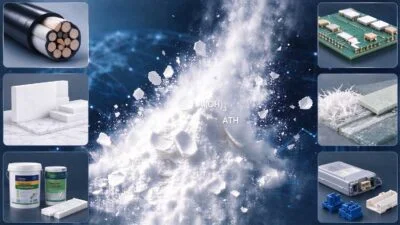
ATH (aluminum hydroxide) ultrafine powder is inherently prone to static charge generation during grinding, classification, pneumatic conveying and collection in air classifier mill systems. Collision, friction and separation between ATH particles, as well as friction between powder and pipe walls, rotor pins, classifier blades and filter media, create static electricity. Uncontrolled static leads to powder agglomeration, wall adhesion, unstable classification, sparking risk, dust explosion hazards, and even accidental discharge shocks to operators. Since ATH is non‑combustible itself, static mainly triggers secondary risks such as dust cloud ignition of other combustible additives, powder clinging and poor flowability. This article covers systematic anti-static practices tailored for ATH grinding lines, based on ath-mill.com low-temperature processing standards.
1. Grounding and equipotential bonding (foundation measure)
Static charge cannot dissipate if equipment sections are electrically isolated.
- Bond all conductive components of the mill circuit: grinding chamber, classifier housing, transition ducts, cyclone separators, airlock valves, baghouse frames, feed hopper and metal support frames. Use heavy-gauge copper bonding jumpers across flanges, flexible hoses and gasket joints where insulating gaskets may break continuity.
- Each equipment section must have a reliable earth ground connection with low resistance. The target grounding resistance should be ≤ 10 Ω for powder processing systems.
- Inspect regularly: paint, corrosion and non-conductive gasket sheets can isolate sections and create floating potential. Remove paint at bonding points to secure metal-to-metal contact.
Note: Stainless steel mill bodies are conductive, but insulated flange seals are a common hidden static trap on ATH lines.
2. Use conductive or static-dissipative material for contact surfaces
Where ATH powder flows at high velocity, avoid pure insulating materials.
- Replace standard non-conductive PU, rubber or plastic hoses with static-dissipative (SD) or conductive hoses with embedded copper wire braids that are bonded to the main grounding network.
- For liners, wear plates and flexible seals, select static-dissipative urethane or conductive ceramics instead of high-resistance insulating plastics.
- Filter bags in the baghouse are critical: use anti-static filter media (conductive polyester or needlefelt with carbon fiber yarn). Ordinary insulating filter bags will build heavy static, causing powder cake to cling tightly and reduce pulse cleaning efficiency. This is a frequent issue for fine ATH grades.
3. Control process air humidity within a proper window
Very dry air accelerates static charge accumulation; overly high humidity causes ATH agglomeration and choking, as covered in the previous article. A balanced humidity setpoint is required.
- Maintain process air relative humidity at 40%–50% RH as the optimal range. Slightly humid air forms a thin conductive surface water film on ATH particles to bleed static away, without creating sticky agglomerates.
- If ambient air is extremely dry (RH <30%), add controlled humidification to the inlet process air. If ambient humidity is too high, use dehumidification and pre-flash drying to keep ATH surface moisture ≤0.2%.
- Avoid local cold spots that cause condensation; condensation creates uneven wetting and localized sticking instead of uniform static dissipation.
4. Optimize airflow and particle velocity to reduce charge generation
Static generation rate rises sharply with particle speed and collision frequency.
- Do not run conveying air velocity excessively high. Set pneumatic transport velocity just above the saltation velocity for your ATH grade, instead of over-speeding airflow.
- Avoid sharp bends, sudden expansions, abrupt contractions and blind tees in the duct layout. These zones create high shear, intense particle-wall friction and charge concentration. Use long-radius bends and streamlined transitions.
- Reduce unnecessary recirculation loads: high circulating load inside the classifier mill means repeated particle-to-particle impacts and continuous static build-up. Stable feed rate and correct classifier speed keep internal loading balanced and lower static output.
5. Static elimination devices: ionizers and static dissipators
For high-fineness ATH grades (D97 < 5 μm) where grounding and humidity alone are insufficient, install active static eliminators.
- AC ionizing bars / ion nozzles: Mounted at the mill outlet, cyclone inlet and baghouse inlet. They produce balanced positive and negative ions to neutralize charged ATH powder clouds. Use explosion-proof certified ionizers for dust zones.
- Passive static dissipator points (sharp-tip static discharge needles) can be fitted on duct walls for supplementary charge relief, but they are less effective than ionizers for dense ultrafine powder clouds.
- Important: Do not place ionizers too close to the grinding zone; high temperature and powder fouling will quickly degrade emitter performance. Keep them in clean, low-temperature transfer sections.
6. Material modification and formulation adjustments
Surface treatment of ATH can reduce static tendency.
- During in-line surface modification, select suitable coupling agents (silane or stearate) that form a semi-conductive surface layer, not just hydrophobic coating. Some pure hydrophobic coatings increase surface resistivity and make static worse.
- Avoid mixing ATH with highly insulating organic additives inside the grinding circuit. Introduce organic modifiers downstream if possible, after static neutralization.
7. Operational and maintenance rules
- Keep all anti-static components clean: powder buildup on ionizer emitters, bonding lugs and conductive filter fibers insulates them and stops static dissipation. Schedule weekly visual checks.
- Test ground resistance periodically with a megohmmeter. Record readings after maintenance, especially after liner replacement or duct modification.
- Train operators to recognize static symptoms: visible sparking at sight glasses, powder flying away from sample ports, powder clinging to plastic sight covers, inconsistent discharge from rotary airlocks, or difficult baghouse cake release. These are early warning signs.
- Sight glasses: use conductive coated glass or install external static dissipators on view ports; ordinary soda-lime glass accumulates heavy static and is a common spark observation point.
8. Safety interlock consideration
For explosion-protected ATH production lines:
- Static monitoring probes can be added at high-risk sections to trigger alarms if excessive surface potential is detected.
- Static control works together with nitrogen inerting when processing special surface-modified ATH with organic coating vapors. Static sparks plus flammable coating vapor create a hazardous combination, even though ATH itself is non-flammable.
Common mistakes to avoid
- Only grounding the main mill body while ignoring filter bags, hoses and cyclone sections.
- Relying on very high humidity to kill static — this trades static risk for agglomeration, choking and poor grinding efficiency.
- Using ordinary non-conductive filter bags and expecting grounding alone to solve static on the filter cake.
- Overlooking paint layers on bonding points, which break the conductive path.
- Running ionizers without regular cleaning, so they stop neutralizing after a few days of ATH powder fouling.
Static electricity prevention for ATH powder processing is a layered system: reliable equipotential grounding and conductive contact surfaces form the base, balanced process air humidity limits charge generation, optimized duct layout and velocity reduce friction, and ionizers provide active neutralization for ultra-fine grades. Proper static control improves powder flow, reduces adhesion and fouling on classifier wheels and ducts, stabilizes particle size distribution, and eliminates spark hazards. When combined with the temperature, humidity and feed-rate controls we covered earlier, it delivers consistent, safe and efficient operation of the air classifier mill for ATH.